
UNIPD and UpToEarth’s Article Published in the Journal of Cleaner Production
A new TEAPOTS publication explores how remote sensing and GIS can help identify where agricultural woody residues could be converted into biochar and used for targeted restoration of degraded rural land.
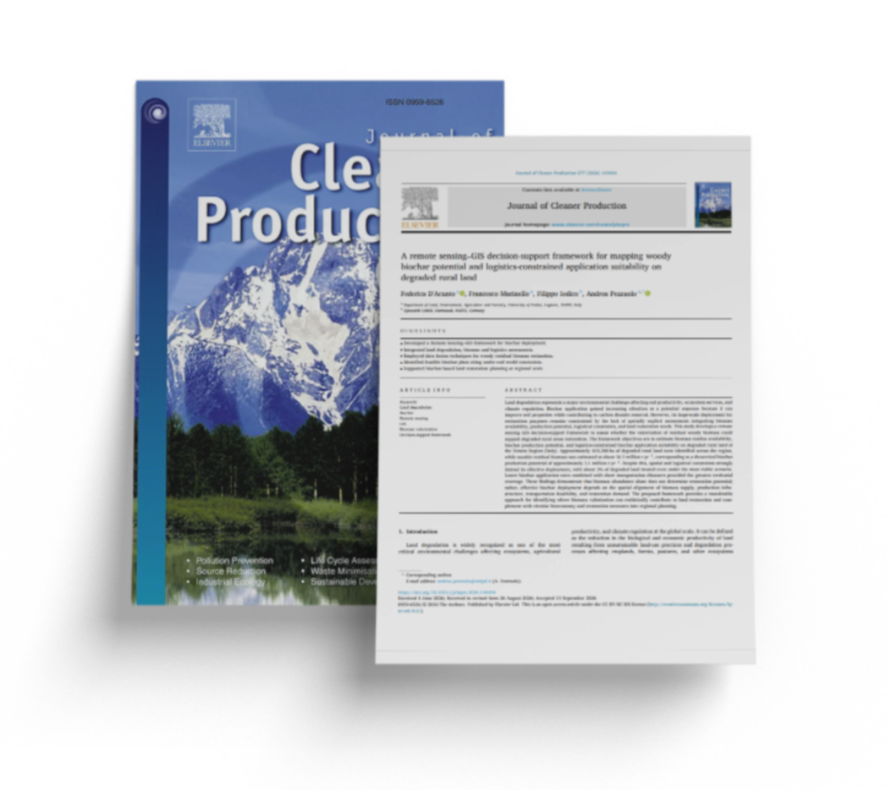
We are pleased to share a new publication from our partners at the University of Padua and UpToEarth, published in the Journal of Cleaner Production. The study explores how agricultural woody residues can be converted into biochar and where this biochar could realistically be applied to support the restoration of degraded rural land.
The study, titled “A remote sensing–GIS decision-support framework for mapping woody biochar potential and logistics-constrained application suitability on degraded rural land”, develops a remote sensing and GIS-based approach combining information on land degradation, woody biomass availability, biochar production, plant locations and transport distances. The analysis focuses on the Veneto Region in Northern Italy, one of the virtual pilots of the TEAPOTS project.
Authored by Federica D’Acunto, Francesco Marinello, Filippo Iodice and Andrea Pezzuolo, the study identified approximately 169,200 ha of degraded rural land and around 10.2 million tonnes of usable residual woody biomass per year. However, once spatial and logistical constraints were considered, only around 2% of the degraded land could be treated even under the most viable scenario. The results show that biomass availability alone is not enough – the location of biomass resources, production facilities, transport infrastructure and degraded land all need to be considered together.
Developed within TEAPOTS, the research also uses characteristics of the project’s experimental pyrolysis unit to assess possible biochar production and deployment scenarios. The proposed framework can be adapted to other regions, helping identify where agricultural residues can realistically support biochar production and targeted land restoration.