
New WU Study Published in Environmental Technology & Innovation
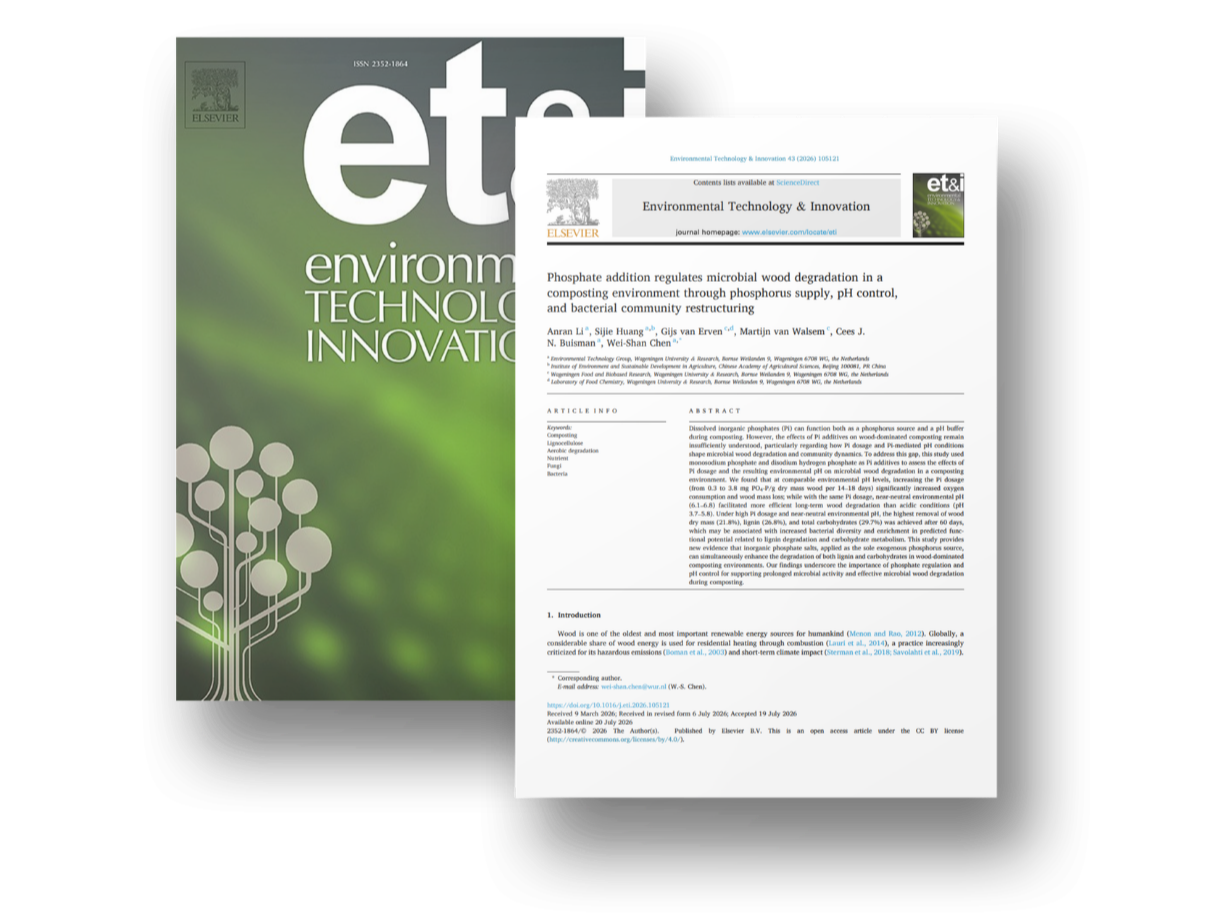
A new research article from Wageningen University (WU) has been published online in Environmental Technology & Innovation. The study investigates how inorganic phosphate addition can support microbial wood degradation by providing phosphorus, regulating pH and influencing microbial communities.
The study, Phosphate addition regulates microbial wood degradation in a composting environment through phosphorus supply, pH control, and bacterial community restructuring, focuses on biological wood oxidation (BWO) – a composting-based process in which microorganisms break down woody biomass and generate low-temperature heat.
The researchers tested different phosphate dosages and pH conditions to understand their effects on microbial activity, wood degradation and fungal and bacterial communities. The results showed that higher phosphate availability increased oxygen consumption and wood mass loss, while maintaining a near-neutral environmental pH of 6.1–6.8 supported more efficient long-term wood degradation.
Under the best-performing conditions, after 60 days the researchers achieved the removal of 21.8% of wood dry mass, 26.8% of lignin and 29.7% of total carbohydrates. These conditions were also associated with increased bacterial diversity and greater predicted functional potential related to lignin degradation and carbohydrate metabolism.
The findings demonstrate the importance of balancing phosphorus supply and pH control when optimising biological wood oxidation. They provide new insights for improving composting and heat recovery systems in which woody materials, including forestry and pruning residues, are used as the primary feedstock.
Congratulations to our WU partners Anran Li, Sijie Huang, Gijs van Erven, Martijn van Walsem, Cees J.N. Buisman and Wei-Shan Chen on the new publication!