
Virtual Pilots: Mapping Agricultural Residues in France and Germany
TEAPOTS is expanding its biomass mapping activities across Europe, with new national-scale assessments revealing the agricultural residue potential of France and Germany. Following earlier mapping activities in the TEAPOTS pilot areas in Italy and Greece and the first virtual pilot in the Netherlands, our partners at Uptoearth have now applied the approach to two of Europe’s major agricultural countries.
Using GIS, Earth Observation data and biomass modelling, the assessments combine crop information with predicted Above-Ground Biomass (AGB), crop-specific Harvest Index values and woody residue coefficients. Agricultural parcel data from RPG 2024 were used for France, while the German assessment draws on DLR CropTypes Germany 2024 at 10 m resolution. The resulting datasets provide polygon-level estimates of agricultural residue potential expressed in tonnes of dry matter (DM).
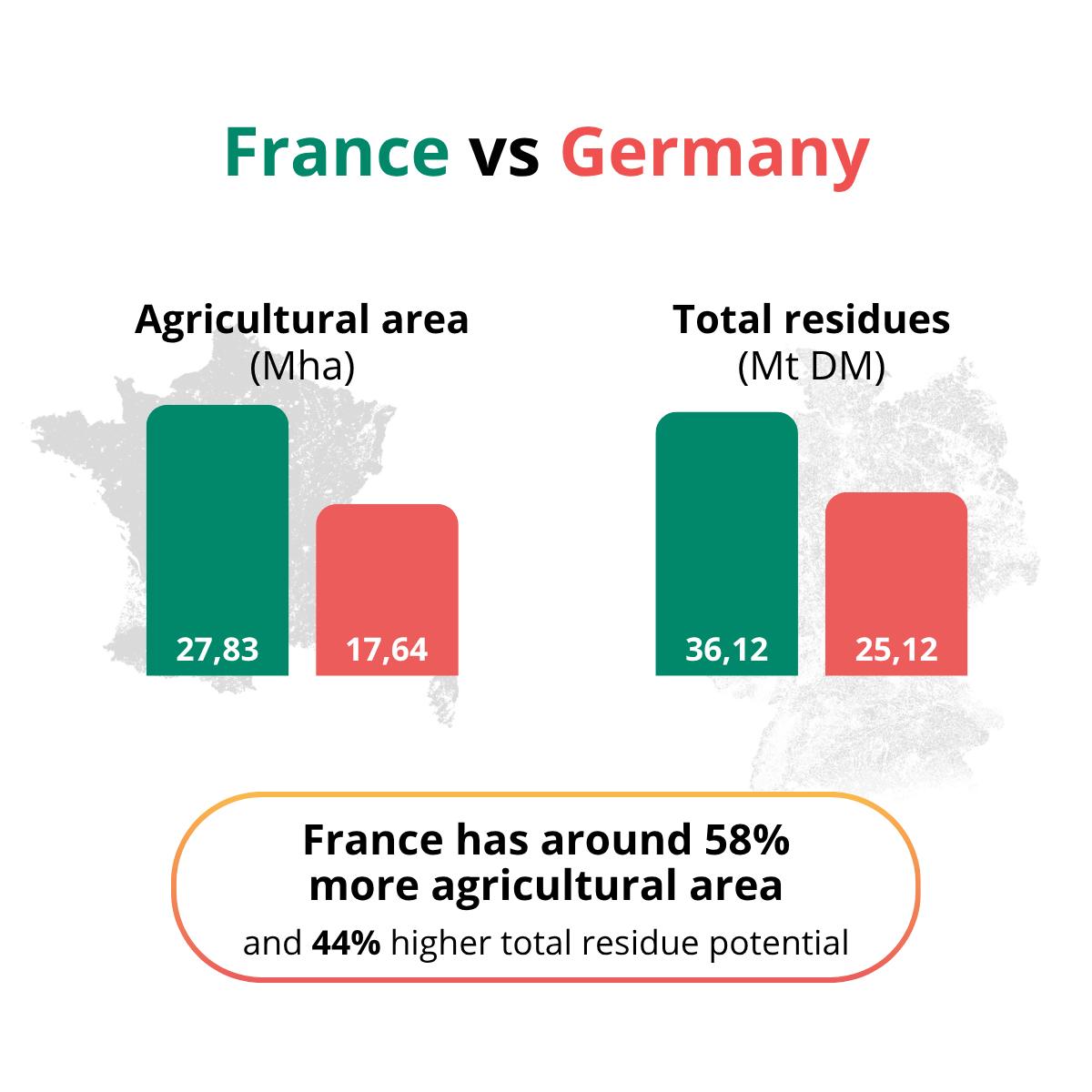
In France, the assessment covers 27.83 million hectares of agricultural land and estimates:
124.24 Mt DM of Above-Ground Biomass
36.12 Mt DM of total agricultural residue potential
Green residues dominate the French profile, accounting for 96.2% of the total.
In Germany, the assessment covers 17.64 million hectares and estimates:
76.34 Mt DM of Above-Ground Biomass
25.12 Mt DM of total agricultural residue potential
Germany has a smaller overall resource base but a stronger contribution from woody agricultural systems, with woody residues representing 15.5% of the total residue potential.
Together, the two virtual pilots cover 45.47 million hectares and identify an estimated 61.24 Mt DM of agricultural residue potential. The comparison highlights two distinct profiles: France has around 58% more agricultural area and 44% higher total residue potential than Germany, while Germany shows a slightly higher residue potential per hectare and a stronger contribution from woody biomass.
These results demonstrate how the TEAPOTS mapping approach can be scaled to the national level and used to support bioenergy planning, sustainable feedstock supply and circular bioeconomy strategies across different agricultural landscapes. The figures represent estimated residue potential in dry matter rather than biomass that is necessarily technically or economically recoverable.
Want to explore the results and comparison in more detail?